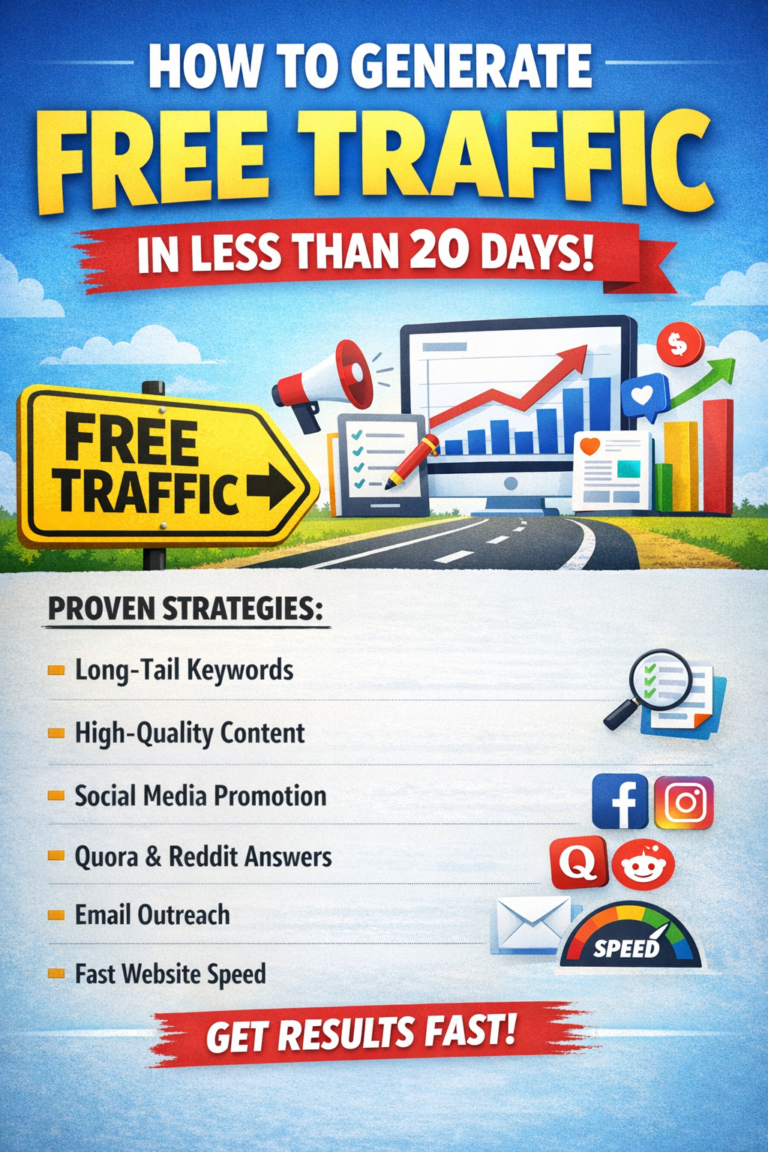
Getting free website traffic in less than 20 days may seem difficult. However, with the right SEO strategies and consistent effort, it is possible to see real results.
Instead of spending money on ads, you can use smart techniques such as long-tail keywords, high-quality content, and social media promotion. In this guide, you will learn practical methods to drive targeted traffic to your website quickly.
1.Define Your Target Audience
Before creating content, determine exactly who you want to attract.
Ask yourself:
- Who is my ideal visitor?
- What problems are they trying to solve?
- What questions do they search for online?
- What type of content would make them click?
- Where does my audience spend time online?
For example, if you run a website about fitness, your audience might be beginners looking for home workouts, healthy recipes, or weight-management tips.
The more specific your audience is, the easier it becomes to create content that attracts the right visitors.
2. Focus on Long-Tail Keywords
First of all, choosing the right keywords is the foundation of SEO. Many beginners target high-competition keywords and fail to rank.
Instead, you should focus on long-tail keywords.
For example:
Bad keyword: “Water tanks”
Good keyword: “Best water tanks for homes in India 2026”
As a result, your chances of ranking on search engines increase.
Tips:
- Use one main keyword per blog
- Include it in the title, headings, and first paragraph3
3. Publish Useful Content
Now turn your keyword research into helpful content.
Don’t write articles simply to insert keywords. Focus on solving a real problem.
A good article should:
- Answer the reader’s main question quickly.
- Provide practical steps.
- Use clear headings and short paragraphs.
- Include examples where useful.
- Link to other relevant pages on your website.
- Give the reader a reason to continue exploring your site.
Try publishing several high-quality articles rather than producing dozens of thin posts.
A Simple Content Formula
You can structure many articles like this:
Problem → Explanation → Step-by-step solution → Examples → Common mistakes → Conclusion
This format is easy to read and gives visitors actionable information.
4. Write High-Quality SEO Content
Content plays a major role in generating free traffic. However, your content must be valuable and easy to read.
Follow this structure:
- Use short paragraphs (2–3 lines)
- Write in simple English
- Use transition words such as however, therefore, in addition, and as a result
Moreover, aim for at least 1000 to 1500 words per blog post.
5. Build Free Backlinks
Backlinks can help your website gain authority and discoverability.
You don’t need to buy hundreds of links. Focus on earning relevant links naturally.
Some approaches include:
- Guest contributions
- Expert interviews
- Digital PR
- Original research
- Useful free resources
- Statistics pages
- Industry directories
- Collaborations with creators
- Linkable guides and tutorials
For example, if you publish an original study or useful industry resource, other websites may reference it in their own articles.
Quality and relevance matter more than simply collecting a large number of backlinks.
6. Repurpose Your Best Content
Look at your analytics and identify which content is receiving the most attention.
Then repurpose it.
A blog post can become a:
Blog → Short video → Social post → Infographic → Email → Community discussion
Repurposing allows you to reach people who prefer different types of content.
It also gives your best ideas multiple opportunities to attract visitors.
7. Improve Your Internal Linking
Internal links are often overlooked.
Suppose you have articles about:
- Keyword research
- SEO content writing
- On-page SEO
- Link building
Connect these articles to one another where relevant.
Internal linking helps visitors discover more content and makes it easier for search engines to understand the relationship between your pages.
Instead of leaving visitors at the end of one article, give them a clear next step.